Over the years practicing law here in Colorado, I’ve had plenty of people sit across from me asking about a Bill of Sale for Firearm in Colorado and whether they actually need one when selling a gun. As a lawyer who has handled real firearm transfer questions, private sales disputes, and ownership issues, I’ve learned that this simple document often matters far more than people realize. In plain terms, a firearm bill of sale is a written record showing that ownership of a gun legally transferred from one person to another. It may look like a simple piece of paperwork, but in my experience, it can protect both the buyer and the seller if questions ever come up later.
Most of the time, the people asking me about this aren’t trying to do anything complicated. It’s usually a neighbor selling a hunting rifle, a family member passing down a shotgun, or two collectors making a private deal. But firearms are not like selling a couch or even a car. Colorado has specific laws around firearm transfers, background checks, and legal responsibility. When those rules aren’t clearly documented, small misunderstandings can turn into serious problems later.
Over the years, I’ve handled situations involving disputed gun ownership, police inquiries, and cases where someone sold a firearm years earlier and suddenly got a call about it. And almost every time, the first thing I ask is simple: “Do you have a bill of sale?”
More often than not, the answer is no.
That’s exactly why I like to explain how firearm bills of sale actually work here in Colorado, what the law really requires, and the mistakes I’ve seen people make when they try to handle private gun sales without proper documentation.
Is a Bill of Sale Required for Firearms in Colorado?
Here’s the honest answer I give clients: Colorado law does not technically require a bill of sale for firearms.
But that doesn’t mean you should skip it.
Colorado law mainly focuses on background checks for most private firearm transfers. Since the passage of Universal Background Check laws (HB13-1229), most private sales must go through a licensed firearm dealer (FFL) who conducts a background check.
However, even when that process is followed, a bill of sale can still be extremely helpful.
Personally, I always recommend one.
Why? Because the background check confirms the legal transfer at the moment of sale, but a bill of sale protects both parties later if questions come up.
I’ve seen situations where:
-
Someone sold a firearm years ago and forgot the buyer’s name
-
A gun later showed up during a police investigation
-
A buyer claimed the firearm was defective
-
Family members disputed who actually owned the gun
When that happens, a simple written record can make things much easier.
When Firearm Bills of Sale Are Especially Important
From my experience handling Colorado firearm matters, there are certain situations where I strongly encourage people to create a bill of sale.
Private firearm sales
Even if the transfer goes through a dealer for the background check, having a written document between buyer and seller is smart.
It establishes:
-
who sold the firearm
-
who bought it
-
when the transaction happened
That timeline can matter a lot if questions arise later.
Family transfers
Colorado law allows certain family transfers without a background check. I see this a lot with hunting rifles being passed down.
But here’s the issue: years later, people forget details.
A bill of sale—or even a simple transfer document—helps prove when ownership changed.
Estate or inherited firearms
Probate cases involving firearms can get messy.
If someone inherited a gun informally and there’s no paperwork, disputes sometimes appear later when estates are settled.
I’ve watched families argue over guns worth a few hundred dollars simply because no one documented the transfer.
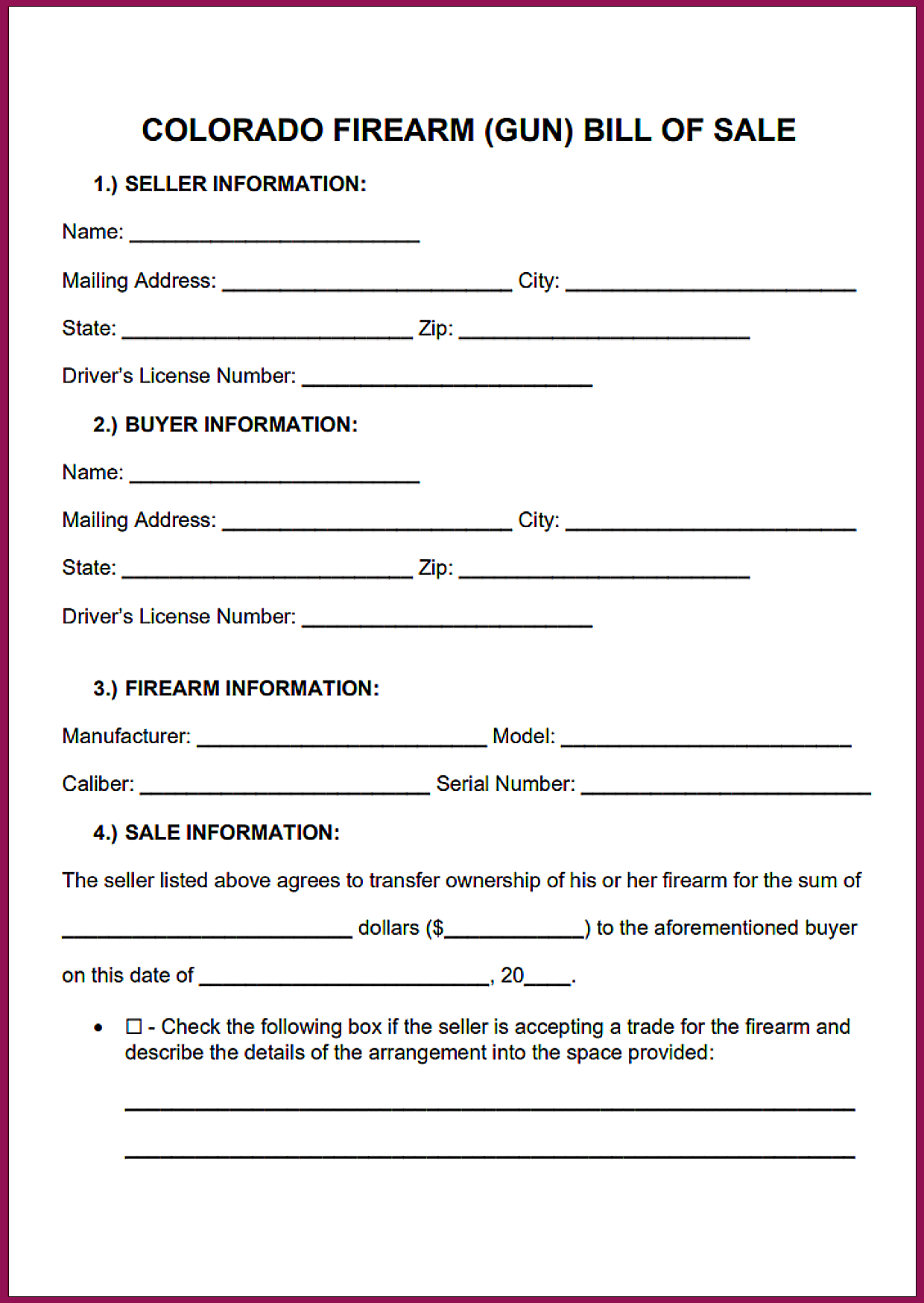
What I Usually Put in a Colorado Firearm Bill of Sale
When I help clients draft one, I keep it straightforward. It doesn’t need to be complicated, but it should clearly identify the firearm and the parties involved.
Here’s what I normally include.
Buyer and seller information
Full names and addresses of both parties.
Sometimes I also recommend including driver’s license numbers, especially for higher-value firearms.
Firearm details
This part matters more than people realize.
I always include:
-
Manufacturer
-
Model
-
Caliber or gauge
-
Serial number
If there’s ever a question about the firearm later, this information is critical.
Sale date and purchase price
The date establishes when ownership changed.
The price isn’t legally required, but I usually recommend including it.
Statement of legal eligibility
I often include a simple statement that the buyer confirms they are legally allowed to possess a firearm under Colorado and federal law.
It doesn’t replace a background check, but it documents the buyer’s representation.
Signatures
Both parties should sign and date the document.
I also encourage each person to keep a copy.
A Situation I’ve Seen More Than Once
Let me give you a real-world example that illustrates why this matters.
A few years ago, someone came into my office after receiving a call from law enforcement. A firearm that had been used during a crime traced back to him through the serial number.
The problem?
He had sold the gun privately about six years earlier.
But there was no paperwork.
No bill of sale. No record of the buyer’s name. Nothing.
Eventually the situation got sorted out, but it caused a lot of stress and required explaining the situation to investigators.
Had he kept a simple bill of sale, it would have been much easier to show when ownership transferred.
That experience is exactly why I tell clients: documentation protects you.
Common Mistakes I See With Firearm Sales
After years of dealing with these situations in Colorado, certain mistakes show up again and again.
Not using a licensed dealer when required
Colorado’s background check law catches people off guard.
Many private firearm transfers must go through an FFL dealer unless they fall into specific exemptions.
Skipping this step can create legal problems.
Forgetting to record the serial number
This one happens constantly.
Without the serial number, a bill of sale becomes much less useful.
Relying only on text messages
I’ve seen people try to prove a gun sale using old text messages.
That’s better than nothing, but it’s far from ideal.
Personally, I prefer a signed document every time.
My Personal Advice for Colorado Firearm Sales
If someone were sitting across my desk asking what to do, here’s exactly what I’d say.
First, make sure the transfer follows Colorado background check laws when required.
Second, create a simple bill of sale documenting the transaction.
Third, keep your copy somewhere safe.
It’s a small step that can prevent big headaches later.
And just to be clear—this isn’t formal legal advice for your specific situation. Laws change, and every situation can be different. If you’re unsure about a firearm transfer, it’s always smart to talk with a qualified attorney or licensed firearm dealer.
Final Thoughts
Firearm ownership carries responsibilities that go beyond just safe storage and handling. Documentation matters too.
Over the years practicing law in Colorado, I’ve learned that most problems around firearm transfers don’t come from bad intentions. They come from missing paperwork and simple misunderstandings about the rules.
A straightforward bill of sale can help avoid those problems.
If you’ve got questions about firearm transfers, bills of sale, or Colorado paperwork in general, feel free to leave a comment below or reach out. I always enjoy hearing real situations people are dealing with, and if I can point you in the right direction, I’m happy to help.
FAQ
Do I legally need a Bill of Sale for a firearm in Colorado?
In most cases, Colorado law does not specifically require a bill of sale for a firearm. However, I strongly recommend using one. A bill of sale creates a written record showing when the firearm changed ownership, which can be very helpful if questions ever arise later about who owned the gun.
Do private firearm sales in Colorado require a background check?
Yes, most private firearm transfers in Colorado must go through a licensed firearms dealer (FFL) who conducts a background check. There are a few limited exceptions, such as certain family transfers, but many private sales still require this step under Colorado law.
What information should be included in a Colorado firearm bill of sale?
A proper bill of sale should include the buyer and seller’s full names and addresses, the firearm’s make, model, caliber, and serial number, the date of the sale, the purchase price, and signatures from both parties. These details help clearly document the transfer of ownership.
Can I write a firearm bill of sale myself in Colorado?
Yes, you can create a simple firearm bill of sale yourself as long as it contains the necessary details about the firearm and the parties involved. Many people also prefer using a printable template to make sure all the important information is included.
Leave a Reply