If you’ve ever bought or sold an ATV here in Colorado, you know it’s rarely some clean, dealership-style transaction. It’s usually two people meeting in a driveway in Castle Rock, out on acreage in Weld County, or off I-25 with cash in hand. The machine gets loaded up, hands are shaken, and everyone assumes the deal is done. What most people don’t realize is that a proper Colorado Vehicle Bill of Sale — especially for an ATV — isn’t just paperwork. It’s the legal document that proves ownership transferred and protects both sides if something goes wrong.
I’m John Riley, a Colorado attorney, and I’ve spent years handling vehicle transfers, title disputes, DMV issues, and private-party sales across this state. I’ve seen what happens when that “simple” bill of sale is missing details — or worse, missing entirely. Sellers get calls from law enforcement months later. Buyers struggle to register with Parks and Wildlife. Disputes pop up that could have been avoided with one properly written document.
An ATV Bill of Sale in Colorado is essentially written proof that ownership of the off-highway vehicle has legally changed hands. It identifies the parties, the vehicle, the price, and the date of transfer. But more importantly — in real life — it’s your protection when paperwork becomes evidence.
Let me explain how this really works here in Colorado, not just what the statute says, but what I’ve seen unfold in actual cases.
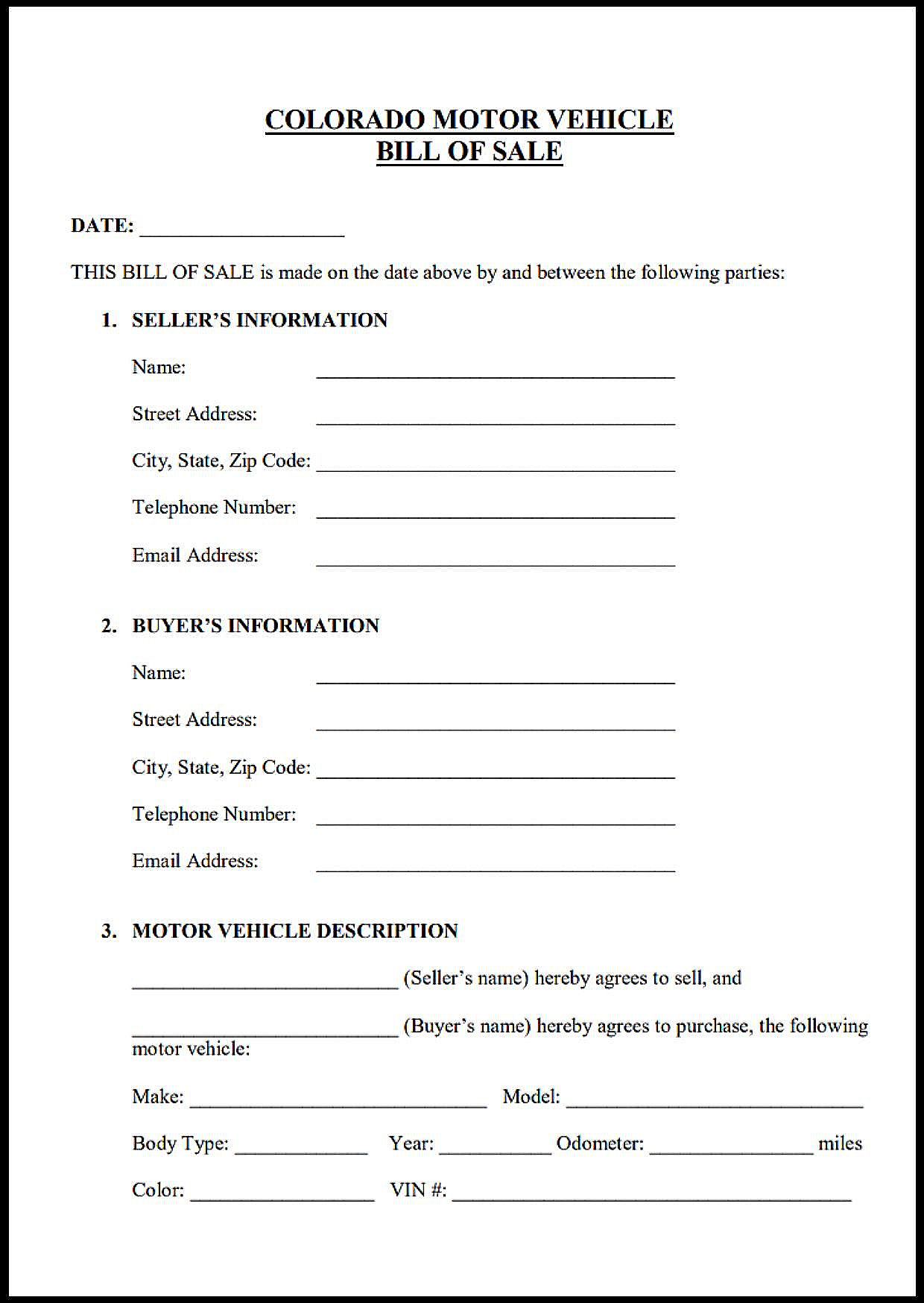
Free Printable Colorado Vehicle Bill of Sale
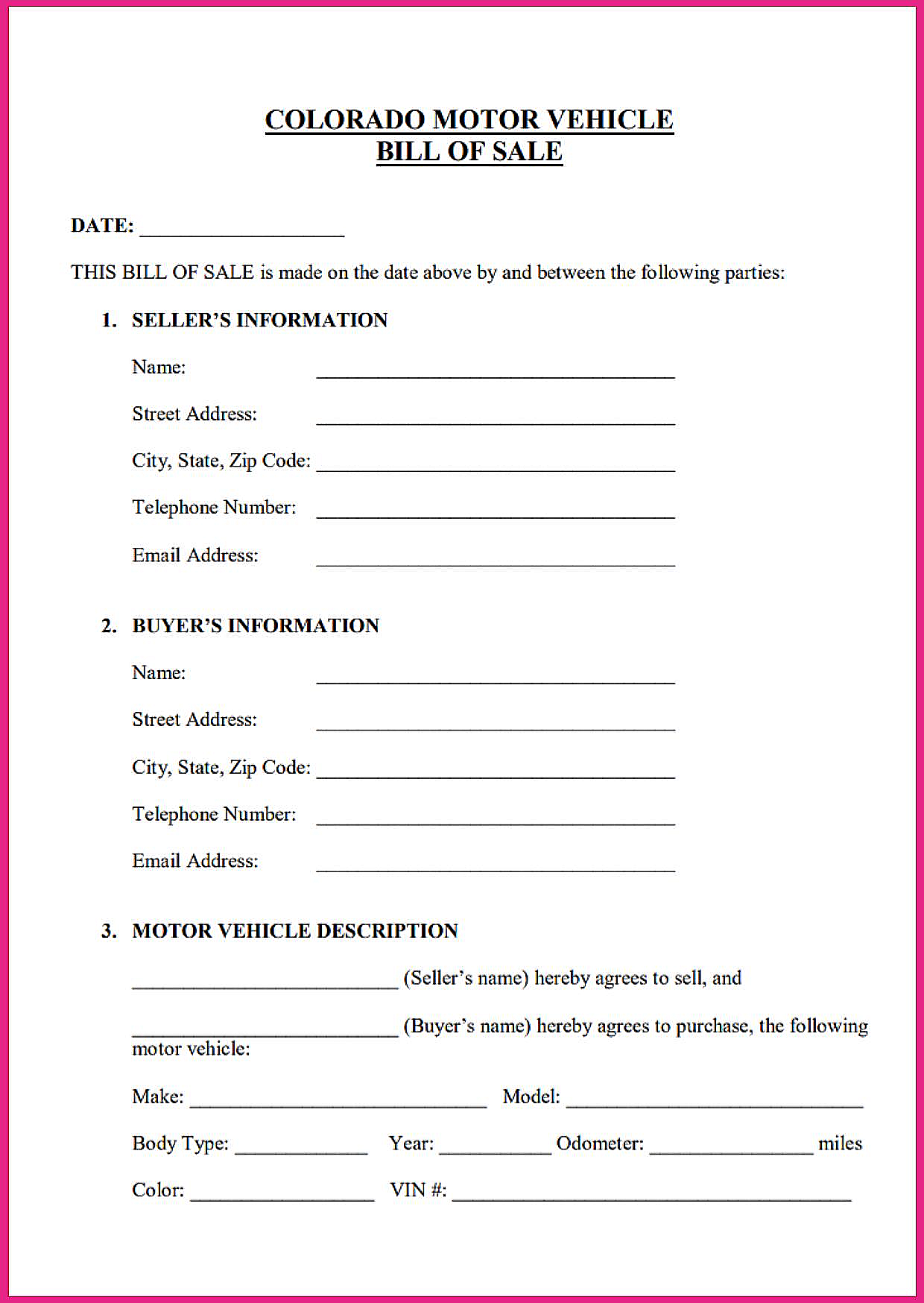
Over the years, I’ve had countless clients walk into my office thinking they could just “write something simple” on paper when selling a vehicle in Colorado. Technically, yes — you can draft your own document. But what I’ve seen time and again is that missing one small detail can cause registration delays, ownership disputes, or even legal complications. A properly structured free printable Colorado Vehicle Bill of Sale isn’t just convenient — it ensures the transfer is clearly documented under Colorado standards and protects both buyer and seller.
When I recommend a printable version to clients, it’s because I want them to have something clean, organized, and legally sound — especially for private-party sales. A structured format reduces mistakes and includes essential fields like VIN, purchase price, and transfer date. And yes, for convenience, I’ve also included this in downloadable PDF format so you can easily print and use it for your transaction.
Colorado Vehicle Bill of Sale PDF
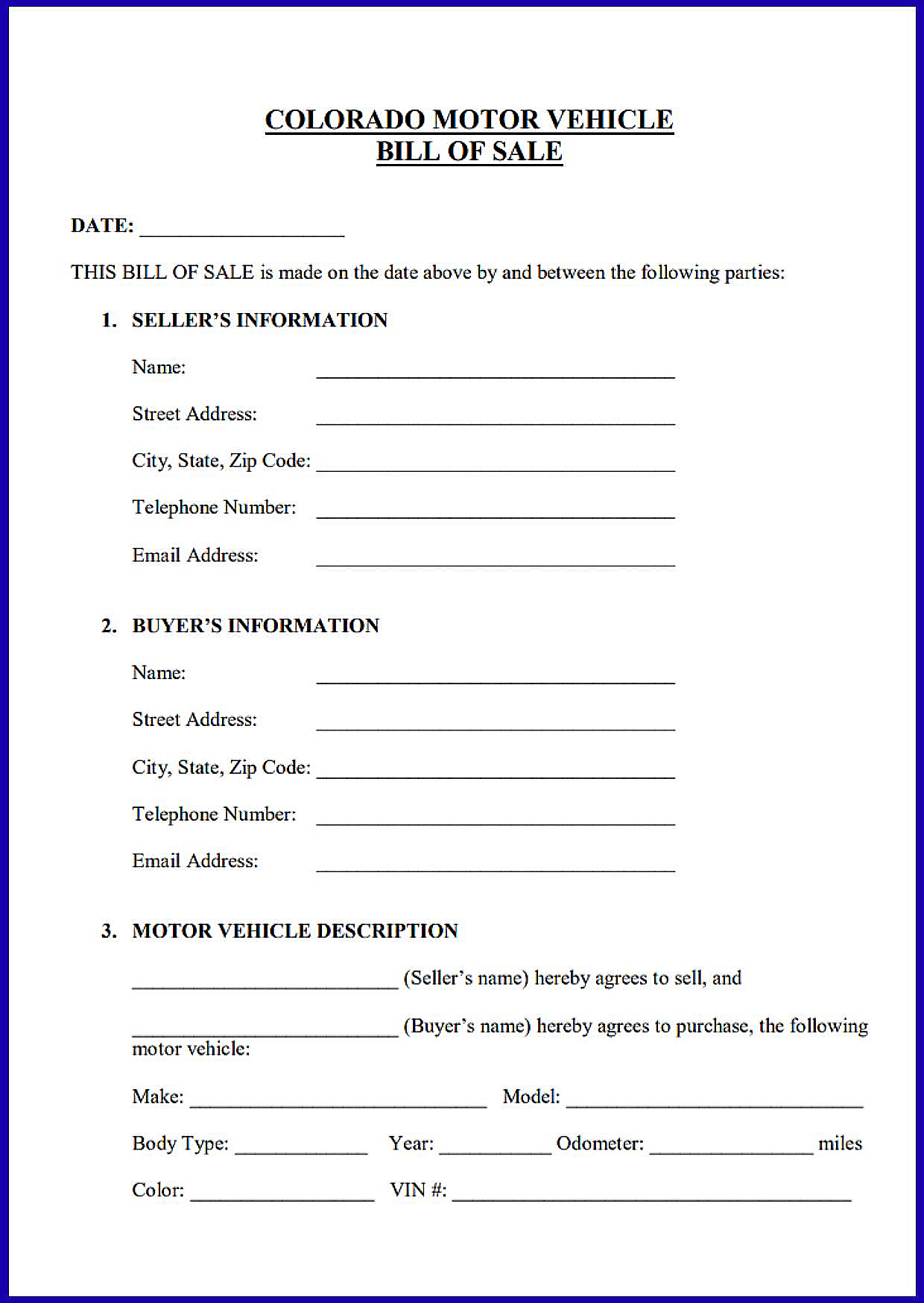
Over the years, I’ve learned that format matters. A Colorado Vehicle Bill of Sale PDF is more than just a digital version — it ensures the document cannot be casually altered after signing. When disputes arise, courts prefer clear, legible, fixed documents. A messy handwritten note scribbled on scrap paper rarely holds up well under scrutiny.
Personally, I strongly prefer using a clean, printable PDF version because it standardizes the information that should always be included — VIN, date of sale, purchase price, and signatures. It minimizes mistakes that I’ve seen cost people time and legal fees. You can download the PDF format of the Colorado Vehicle Bill of Sale and keep both digital and printed copies for your records.
Colorado Vehicle Bill of Sale Form
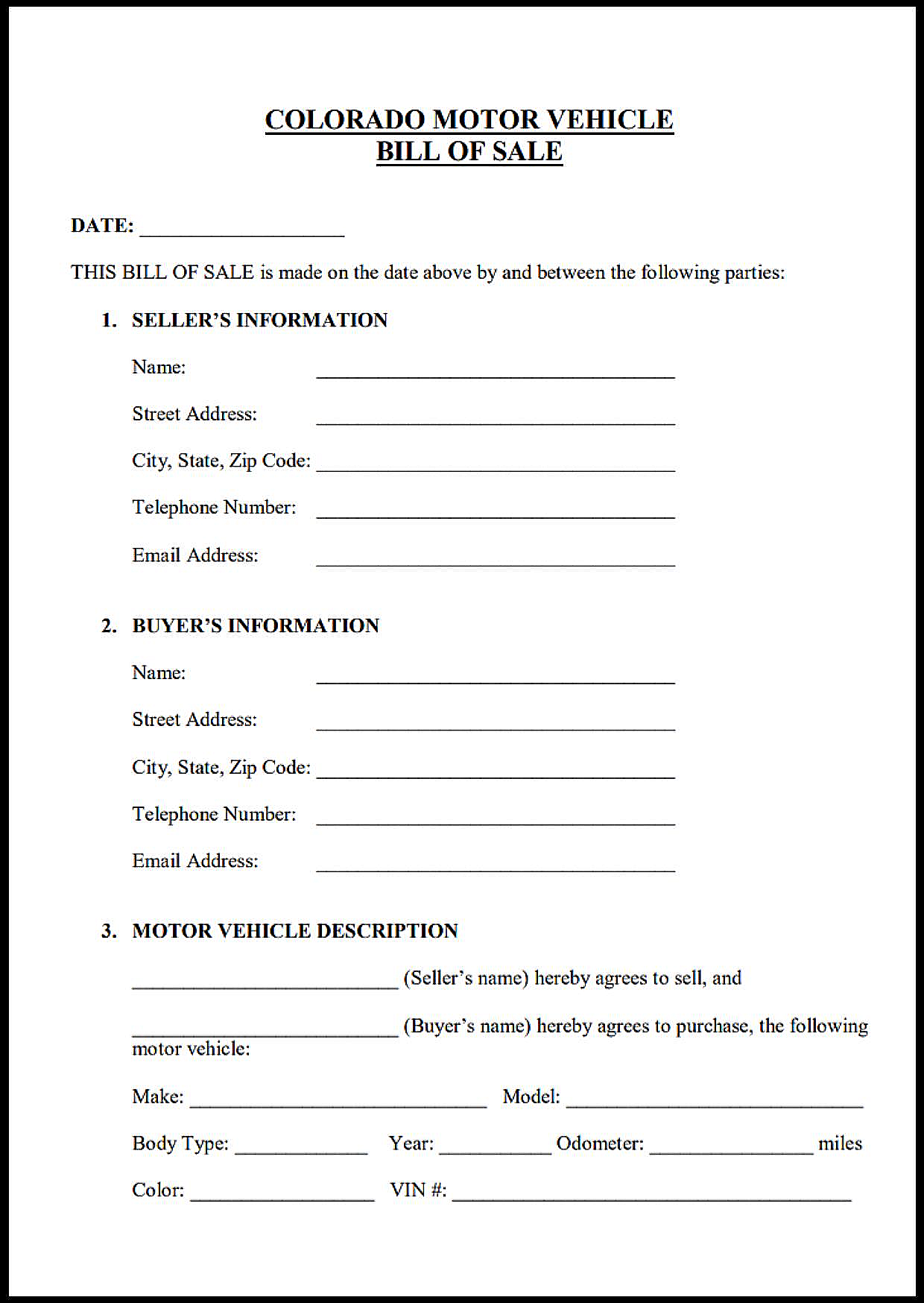
There’s a difference between a random template online and a proper Colorado Vehicle Bill of Sale form that aligns with state practices. While Colorado does not always mandate notarization for private vehicle sales, the form still needs to meet practical legal standards. I’ve seen forms missing critical information like odometer disclosures or incomplete buyer details — and those gaps create real problems.
A well-prepared Colorado Vehicle Bill of Sale form clearly identifies the vehicle, confirms lawful ownership, and documents the exact transfer date. Those details matter when dealing with the Colorado DMV or in the event of a title dispute. To make things easier, you can download the PDF format of the Colorado Vehicle Bill of Sale form and use it as a structured guide during your transaction.
Colorado Vehicle Bill of Sale Template
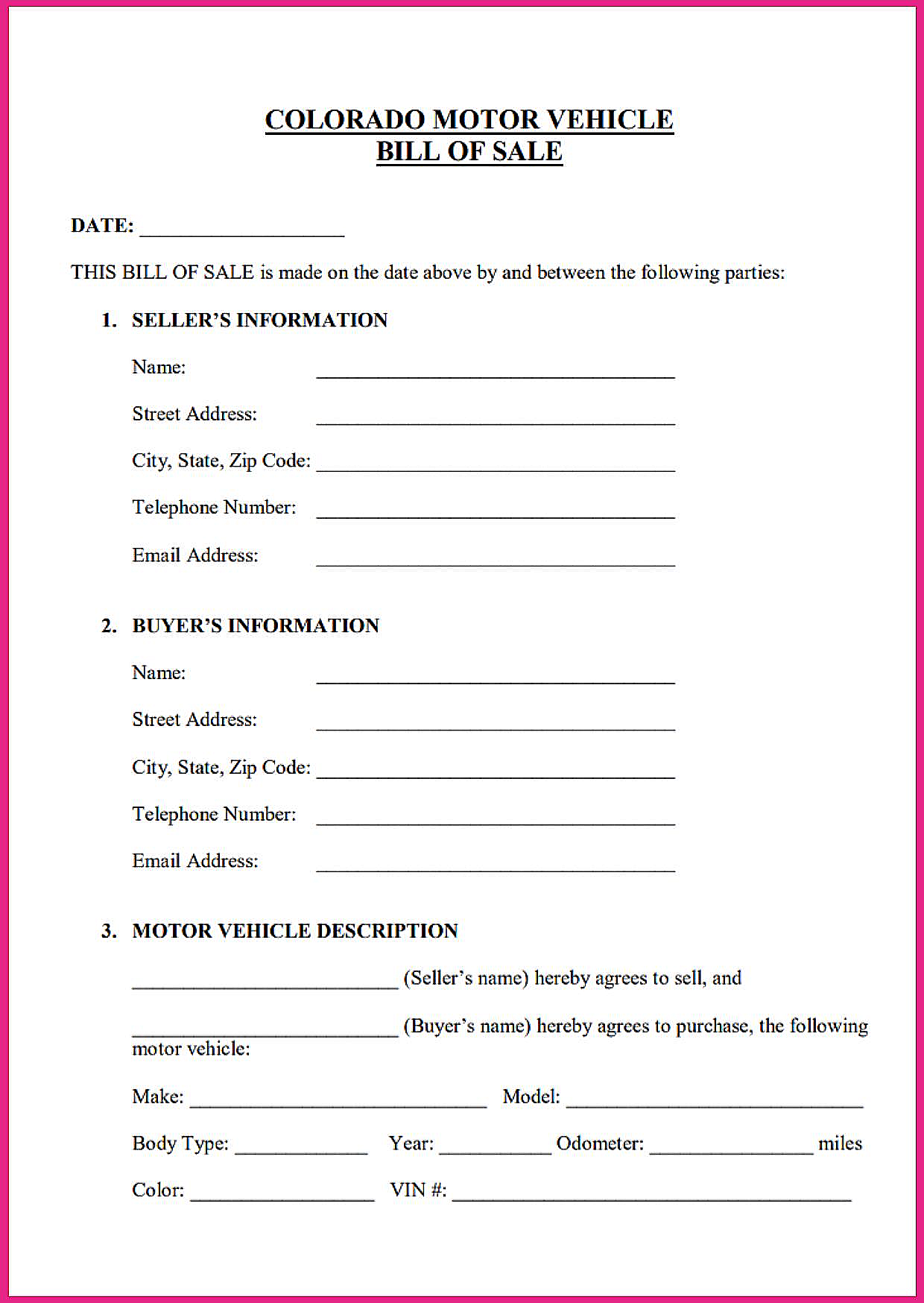
I understand why people search for a Colorado Vehicle Bill of Sale template — they want something quick and easy. But here’s what I’ve learned after years practicing in Colorado: a template should be treated as a starting point, not a shortcut. Every transaction has its own facts, and sometimes small custom language can prevent big disputes later.
A solid template should include vehicle description, VIN verification, sale price, “as-is” language, and signatures from both parties. I always advise clients to review the template carefully before signing, especially in private-party sales. You can download the PDF format of the Colorado Vehicle Bill of Sale template and adapt it properly to your situation to avoid unnecessary legal complications down the road.
First — Does an ATV Even Need a Title in Colorado?
Here’s where people get confused.
In Colorado, most ATVs (OHVs — Off-Highway Vehicles) are not titled like cars through the county DMV. Instead, they’re typically registered through Colorado Parks and Wildlife.
That means:
-
There usually isn’t a “title” like a car title.
-
Ownership proof often comes down to a Bill of Sale and prior registration.
If the ATV was purchased from a dealer, there may be a Manufacturer’s Statement of Origin (MSO). But in private-party sales? The Bill of Sale is king.
And yes — I’ve handled disputes where the only proof of ownership was a handwritten receipt on notebook paper.
Is an ATV Bill of Sale Required in Colorado?
Legally? Colorado doesn’t have one specific mandatory ATV bill of sale form the way it does for motor vehicles under Colorado Division of Motor Vehicles.
But practically speaking?
I always tell clients:
Never transfer an ATV without a detailed written bill of sale.
Because here’s what I’ve seen happen:
-
Buyer registers the ATV but seller never keeps proof.
-
ATV is used in a trespass or accident.
-
Law enforcement tracks the VIN.
-
Guess whose name is still floating around in old records?
That seller ends up calling me.
What I Always Include in a Colorado ATV Bill of Sale
When I draft one — or review one — I make sure it includes:
-
Full legal names and addresses of buyer and seller
-
Date of sale
-
Purchase price
-
Complete ATV description:
-
Year
-
Make
-
Model
-
VIN (Vehicle Identification Number)
-
-
Odometer reading (if applicable)
-
Clear statement that it’s sold “as-is”
-
Signatures of both parties
Personally, I strongly prefer adding:
-
Driver’s license numbers (at least partially)
-
A line stating the seller affirms lawful ownership
-
A statement that buyer assumes all responsibility after transfer
Because what I’ve learned is this:
Disputes don’t happen when everything goes smoothly. They happen when something goes wrong.
And when it goes wrong, details matter.
Common Mistakes I See in Colorado ATV Sales
Let me give you a real-world example.
A gentleman from El Paso County sold his ATV. He wrote:
“Sold ATV for $2,500. — Mike”
That was it.
No VIN.
No date.
No buyer information.
Six months later, the ATV was abandoned on private land. Law enforcement ran the VIN and traced it back to him. He had to hire counsel to sort out what should’ve been a simple transfer.
That entire situation could’ve been avoided with a proper document.
Other mistakes I see:
-
VIN written incorrectly (one wrong digit creates chaos)
-
Seller forgetting to remove old registration stickers
-
Buyer not registering promptly with Colorado Parks and Wildlife
-
No copy kept by seller
I always tell people — make two signed copies. Each of you walks away with one. Take photos of it on your phone. It sounds simple, but I’ve seen it save people thousands in legal fees.
Registration After the Sale (What Buyers Need to Do)
After buying an ATV in Colorado, the buyer generally needs to register it through Colorado Parks and Wildlife.
That typically requires:
-
Bill of Sale
-
Prior registration number (if available)
-
Payment of registration fees
If you’re using the ATV strictly on private land, registration rules can vary — but I still recommend formal documentation. Because the moment it’s transported, sold again, or involved in a dispute, paperwork becomes critical.
Why the “As-Is” Language Matters
In my experience, most private ATV sales are “as-is.” That means the buyer accepts the condition of the machine at the time of sale.
But if you don’t clearly state that in writing, you leave the door open to arguments like:
-
“He told me the engine was rebuilt.”
-
“She said it never had water damage.”
-
“He guaranteed it ran perfectly.”
I’ve defended sellers who thought a handshake was enough. It rarely is.
A simple sentence like:
“The ATV is sold as-is, with no warranties expressed or implied.”
can shut down a lot of potential conflict.
Title Disputes — Yes, They Happen with ATVs
Even though ATVs don’t usually have traditional titles in Colorado, ownership disputes still come up.
I’ve handled cases involving:
-
Stolen ATVs resold unknowingly
-
Family disputes after a death
-
Divorce cases where the ATV “wasn’t on paper”
-
Buyers who never registered and then tried to claim prior ownership
In those situations, the Bill of Sale becomes Exhibit A.
And if it’s sloppy? The case gets complicated fast.
My Practical Advice (If You’re Sitting in My Office)
If you’re selling:
-
Verify the VIN before writing anything.
-
Write a detailed bill of sale.
-
Keep a copy forever — not just a few months.
-
Remove any registration stickers.
-
Document the condition (photos help).
If you’re buying:
-
Match the VIN on the ATV to the Bill of Sale.
-
Ask for prior registration proof.
-
Register it promptly.
-
Don’t skip paperwork just because it’s a “small” purchase.
What I’ve learned over the years is this:
The smaller the transaction feels, the more likely people are to cut corners. And those are the cases that end up in my office.
A Quick Legal Reality Check
This isn’t formal legal advice for your specific situation — I don’t know your facts yet. Colorado law can change, and every case has its own wrinkles. But this is how these issues play out in real life here, not just in statutes.
And if there’s one thing I’ve seen consistently, it’s this:
Good paperwork prevents bad lawsuits.
FAQs
Is a Bill of Sale required in Colorado for a vehicle?
In most private-party sales in Colorado, yes — I strongly recommend it, even when it’s not strictly mandatory in every situation. While the Colorado Division of Motor Vehicles primarily relies on the signed title for ownership transfer, I’ve seen plenty of disputes where the title alone wasn’t enough. A properly written Colorado Vehicle Bill of Sale adds a clear paper trail showing the date, price, and terms of the transfer.
From my experience, when something goes wrong — unpaid tolls, parking tickets, or even accidents — the first question becomes: When exactly did ownership change? That’s where your bill of sale protects you.
Does a Colorado Vehicle Bill of Sale need to be notarized?
Generally, no — Colorado does not require a vehicle bill of sale to be notarized. However, I’ll tell you this: just because it’s not required doesn’t mean it’s a bad idea. In higher-value transactions, I sometimes suggest notarization simply to eliminate any argument that a signature was forged or disputed later.
Most standard vehicle sales between private parties don’t need notarization if the title is properly signed. But if there’s any tension between buyer and seller, or the deal feels even slightly uncertain, adding that extra layer can save you serious trouble down the road.
What information must be included in a Colorado Vehicle Bill of Sale?
At minimum, I always advise including:
-
Full legal names and addresses of both parties
-
Vehicle year, make, model
-
VIN (Vehicle Identification Number)
-
Sale price
-
Date of transfer
-
Signatures of both buyer and seller
In my legal work, the most common mistake I see is an incorrect VIN or missing date. That small oversight can delay DMV processing or complicate a title dispute. The clearer and more detailed the document, the stronger your protection.
Can I write my own Bill of Sale in Colorado?
Yes, you absolutely can write your own — Colorado doesn’t require a specific mandatory format for private sales. But I’ll be honest: I’ve reviewed many handwritten bills of sale that created more problems than they solved. Missing language like “sold as-is,” incomplete vehicle descriptions, or vague payment terms often lead to disagreements later.
Personally, I always prefer using a structured template or PDF form to make sure nothing critical gets left out. It keeps things clean, professional, and defensible if the document ever needs to stand up in court.
Leave a Reply